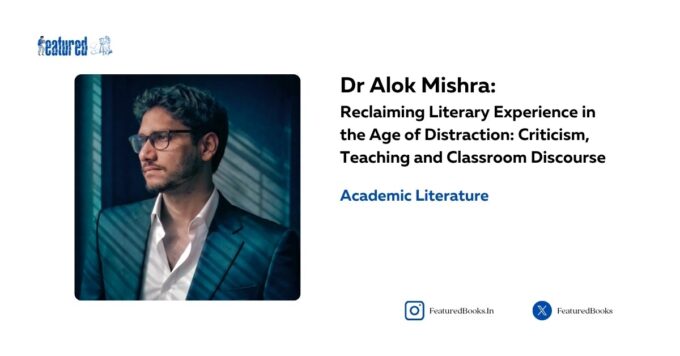
In the evolving landscape of English literary studies in India, where classrooms increasingly negotiate the pressures of digitisation, shortened attention spans and the expanding presence of artificial intelligence, Dr Alok Mishra stands out as a thoughtful and grounded voice. Serving as Assistant Professor of English Literature at Nava Nalanda Mahavihara, a deemed university situated in the historically resonant region of Nalanda, Bihar, Mishra’s work is marked by a consistent effort to reconcile the classical ethos of literary learning with the cognitive and cultural realities of contemporary students.
His academic identity is shaped not only by institutional affiliation but also by an active engagement with pedagogy, criticism and public literary discourse. Drawing equally from his experiences as a student and a teacher, Mishra has developed a distinctive approach that resists both rigid traditionalism and uncritical modernisation. Instead, he advocates a carefully balanced method that restores literature to its experiential core while acknowledging the transformed habits of reading in the digital age.
At the heart of Dr Alok Mishra’s pedagogical philosophy lies a simple but often overlooked principle: literature must begin with the text itself. In an academic culture where theoretical frameworks frequently precede and sometimes overshadow primary engagement, he cautions against introducing students prematurely to dense conceptual vocabularies such as deconstruction, postcoloniality or intertextuality. For him, such approaches risk turning literature into a coded discipline, accessible only through specialised jargon rather than lived experience.
Mishra’s method reverses this sequence. He encourages students to encounter the text directly, to read, respond, question and even misinterpret without immediate correction. These early, imperfect responses are not treated as errors but as essential stages in the formation of literary sensitivity. They generate a sense of ownership and curiosity, which can later be channelled into more structured analysis. Only after this initial engagement does he introduce theoretical concepts, allowing them to emerge organically from the students’ own observations. In doing so, theory becomes a lens rather than a barrier, a tool for refinement rather than a prerequisite for understanding.
This emphasis on experiential reading is closely tied to Mishra’s belief that literature demands patience, attentiveness and an openness to ambiguity. He frequently invokes the idea of “listening” to a text, not merely in the auditory sense, but as a metaphor for attending to nuance. The cadence of a sentence, the pause in a line of poetry, the silence surrounding a character’s absence, these, for him, are as significant as overt meaning. In an educational environment increasingly shaped by quick summaries and algorithmic shortcuts, such an approach represents a deliberate slowing down, an insistence that understanding cannot be rushed.
His critical orientation complements this pedagogical stance. Dr Alok Mishra’s approach to literary criticism is marked by an attentiveness to what remains unsaid. He encourages students to “listen to silences” within texts, to examine omissions, marginal voices and narrative gaps. Drawing upon frameworks such as feminism, postcolonialism and psychoanalysis, he guides learners to ask not only what a text reveals but also what it conceals, and for whom. Importantly, this inquiry is framed not as an exercise in ideological assertion but as a balanced exploration that resists premature judgment. The aim is to cultivate ethical sensitivity alongside analytical rigour.
Mishra’s work also reflects a sustained engagement with the practical challenges of teaching literature in non-native English contexts, particularly in India. He recognises that many students enter the classroom with limited linguistic confidence, often hesitant to articulate their responses for fear of grammatical error. His response is to create an environment where tentative expression is valued over linguistic perfection. By prioritising thought over form in the early stages, he reduces inhibition and encourages participation. Language, in his classroom, becomes a medium of exploration rather than a barrier to entry.
Equally significant is his attention to the mismatch between contemporary student habits and traditional pedagogical expectations. He observes that many learners arrive with what he terms “fragmented exposure” to texts, shaped by digital consumption patterns that favour skimming, summaries and instant clarity. Teachers, by contrast, often operate with layered interpretations and historical depth. This disparity can turn classrooms into uneven spaces where dialogue collapses into passive listening or mechanical note-taking.
To address this, Mishra advocates adaptive teaching methods that align with students’ cognitive habits without surrendering intellectual depth. He acknowledges the double-edged nature of digital tools. While they risk encouraging superficial engagement, they also offer opportunities for creative integration. Audio readings, visual adaptations and interactive discussions can serve as entry points into complex texts, provided they are used to complement rather than replace close reading. His approach is not to reject technology, but to discipline its use within a framework that preserves sustained attention.
Assessment, too, forms a crucial part of his reformist vision. Mishra is critical of conventional examination systems that reward memorised responses and fixed interpretations. He proposes more flexible modes of evaluation that prioritise independent thinking, textual evidence and reasoned argument. Students are encouraged to justify their interpretations rather than reproduce canonical readings. In this model, there is no singular “correct” meaning. What matters is coherence, engagement and the ability to support claims with textual insight.
One of the most illustrative aspects of his teaching method is his structured approach to literary analysis, particularly in the context of poetry. His framework for critical appreciation emphasises clarity and progression. It begins with concise contextualisation, moves into direct engagement with themes, imagery and stylistic devices, and incorporates comparative reflection before arriving at a thoughtful conclusion. This method exemplifies his broader pedagogical aim: to make literary analysis accessible without diluting its complexity. Students are trained not only to understand a poem but to articulate that understanding with precision and depth.
Beyond the classroom, Mishra’s contributions extend into public literary discourse through platforms such as English Literature Education, where he publishes editorials, teaching guides and theoretical reflections. These writings reflect a consistent concern with the evolving conditions of literary study and a commitment to making critical thought accessible to a wider audience. His work often returns to a central question: how can literature remain meaningful in a world increasingly oriented towards speed, utility and measurable outcomes?
His answer lies in reasserting the intrinsic value of literary engagement. For Mishra, literature is not merely an academic discipline but a mode of perception. It refines the ability to observe, to empathise and to think critically. In an age dominated by data and immediacy, these qualities acquire renewed significance. He argues that literature’s non-utilitarian nature is precisely what makes it indispensable. It offers a space where complexity can be sustained, where ambiguity is not resolved but explored.
There is also a subtle but important continuity between Mishra’s work and the historical legacy of Nalanda. While he does not explicitly position his pedagogy as a revivalist project, his emphasis on dialogue, mutual inquiry and intellectual humility echoes the traditions associated with ancient centres of learning in the region. The classroom, in his vision, is not a site of unilateral transmission but a collaborative space where teacher and student engage in shared exploration.
In an era where literature education faces the dual pressures of technological disruption and declining attention spans, Dr Alok Mishra’s work represents a thoughtful recalibration rather than a reactionary retreat. His approach neither romanticises the past nor capitulates to the present. Instead, it seeks to create a middle path, one that acknowledges changing realities while preserving the depth, patience and sensitivity that literature demands.
What emerges from his work is not a rigid methodology but an evolving practice, responsive to context and grounded in experience. It is this adaptability, combined with a clear commitment to intellectual integrity, that defines his contribution as both a teacher and a critic. In the quiet classrooms of Nalanda, and through his wider engagements, Mishra continues to argue for a simple yet demanding proposition: that literature, if taught with care and openness, still has the power to transform how we read, think and understand the world.
Nishant for Featured Books