
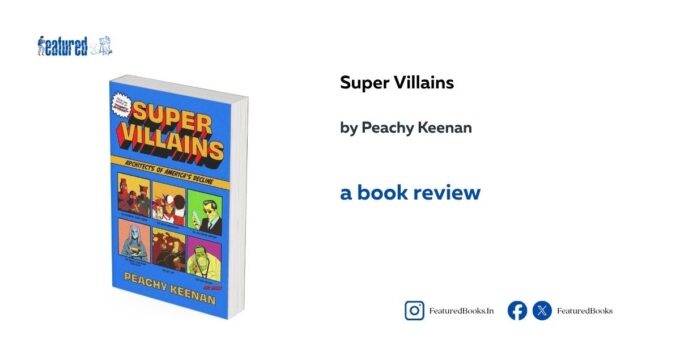
Peachy Keenan’s Supervillains is an unabashedly partisan book that converts contemporary American political and cultural conflict into the vocabulary of comic-book mythology. Its central conceit is simple but strategically effective: the people, institutions, movements, and cultural tendencies Keenan regards as destructive are transformed into “supervillains,” while those who resist them become “superheroes.” The device enables the author to move rapidly between political criticism, cultural commentary, personal experience and satire without ever pretending to the conventions of neutral analysis. The result is an energetic, provocative and often extremely funny polemic, but one whose greatest strength is also its principal intellectual limitation. Keenan writes to expose, ridicule and mobilise rather than to deliberate with ideological opponents. Her book is therefore most persuasive when it uses humour to illuminate contradictions within contemporary institutions and least persuasive when its comic categories substitute for careful distinctions between evidence, interpretation and accusation.
The architecture of Supervillains reflects this purpose. Part One, “Meet the Supervillains,” contains chapters devoted to doctors, immigration advocates, feminists, LGBT activists, criminal-justice reformers, DEI administrators, academics, Hollywood figures, billionaire philanthropists, media personalities, wealthy financiers, biohackers and California political culture. Part Two enlarges the fictional universe through “Supervillain Dynasties,” “Lesser Villains” and, particularly revealingly, “How to Speak Supervillain,” a satirical lexicon that translates progressive terminology into Keenan’s preferred meanings. Part Three then turns from identification to strategy, ending with “Sensible, Common-Sense Supervillain Control” and “Wanted: A Supervillain Great Replacement.” This progression is important. The book is not merely a catalogue of people the author dislikes. It attempts to establish a worldview in which apparently unrelated developments in medicine, education, entertainment, immigration, corporate culture and family life are manifestations of a common ideological system. Keenan makes that interpretive ambition explicit in her introductory instructions, where she argues that the task is not simply to hate these figures but to “learn to laugh at the supervillains.” Satire, for her, becomes a political instrument.
That satirical method is immediately visible in the opening chapter, “Sick Doctors.” Keenan begins not with statistics or institutional history but with a comic portrait of health professionals: “They’re pallid. Prematurely aged. Iron deficient. They’ve got poor muscle tone.” The exaggerated physiological imagery establishes her tone at once. Yet the chapter then shifts into a serious personal account concerning her sister’s adverse reaction to metoclopramide, after which Keenan broadens the anecdote into a critique of medical authority, pharmaceutical practice and institutional trust. This juxtaposition is characteristic of the book. A personal story supplies emotional credibility; satire supplies rhetorical force; a wider ideological conclusion follows. The technique is effective because the reader sees that Keenan’s distrust of institutions is not presented merely as an abstract political preference. It has a narrative origin. At the same time, the movement from one person’s medical experience to larger conclusions about medicine illustrates a recurring problem in the book: the distinction between a powerful anecdote and representative evidence is often blurred.
The same tendency becomes more pronounced in the chapters on immigration, DEI and criminal justice. In “Great Replacers,” Keenan presents rapid demographic change as part of a deliberate ideological project and gives the phenomenon an intentionally loaded name. In “DEI Hards,” she argues that the language of diversity and inclusion has become a vehicle for exclusion, racial preferences and bureaucratic conformity. She is particularly effective when she identifies the rhetorical contradiction she sees in institutional language. The sentence “When the ‘under-represented’ are the only ones deemed worthy of representation, the lie of ‘diversity, equity, and inclusion’ gives way to the true goal of DEI: homogeneity” is a good example of the book’s characteristic argumentative move. Whether or not one accepts the conclusion, the formulation is memorable because it compresses a complicated institutional debate into a sharp paradox. Similarly, the mock glossary in Chapter 16 turns phrases such as “Birthing person,” “Centering,” “Conspiracy theory,” “Diversity” and “Equity” into deliberately hostile translations. As satire, this is one of the book’s clearest successes. It demonstrates Keenan’s ear for political language and her talent for turning bureaucratic terminology into comic material.
Yet the very compression that gives these passages their punch also reduces analytical complexity. “How to Speak Supervillain” is intentionally unfair, because unfairness is part of the joke. “Birthing person = Your mom” is not an argument about terminology; it is a punchline. “Democratic Socialism = Communism” is rhetorically obvious rather than historically precise. “Person of size = Person who needs to buy two airplane tickets” is designed to provoke rather than investigate the politics of language. The glossary works because the reader already understands the culture-war disagreement behind the jokes. It would be a mistake, however, to regard the glossary as evidence that settles those disagreements. Keenan is strongest when her satire exposes the emotional or ideological charge of a phrase, not when she uses comic equivalence as a substitute for definition.
The book’s chapter on “Illiterati” reveals another important dimension of Keenan’s project. Here she extends the supervillain concept into literary and cultural institutions, arguing that museums, publishing, theatre and higher education have been ideologically colonised. This is where the book becomes more than a collection of political grievances. Keenan is defending a particular vision of culture. She clearly values literature, art, historical continuity and the inherited canon, and she fears that political ideology is displacing aesthetic and intellectual judgment. Her objections to Hollywood follow the same pattern. In “Hollywood Wreckers,” she attacks what she sees as formulaic production, ideological hiring, derivative storytelling and political messaging. Her discussion of contemporary entertainment is not especially original in its broad diagnosis, but her comic treatment of cultural decline gives it personality. She is particularly good at reducing grand institutional claims to memorable cultural judgments. Her complaint is not merely that Hollywood has become politically progressive; it is that political self-consciousness has damaged its capacity to entertain.
The chapters on wealth and media further demonstrate Keenan’s gift for constructing recurring caricatures. “Fat Cats” attacks billionaires and investment managers who, in her account, use their wealth to reshape public institutions according to ideological preferences. Her phrase “effective selfishness,” contrasted with “effective altruism,” is a particularly neat example of her ability to create a memorable formulation from a familiar political argument. The chapter on media likewise argues that the professional press does not simply report reality but constructs a curated representation of it. The broader claim is familiar, but the author presents it in the language of a cultural insurgency. This is one of the most consistent features of Supervillains: Keenan is less interested in proving that individual institutions have made mistakes than in persuading readers that a coherent cultural establishment has developed its own vocabulary, incentives and mechanisms of power.
The chapter “Biohackers” is comparatively more nuanced, and therefore, especially revealing. Keenan states, “I LOVE TECHNOLOGY,” before immediately distinguishing between technologies she welcomes and forms of technological intervention she distrusts. Her discussion of IVF, genetic screening, egg freezing and reproductive technologies shows that she is not rejecting technological progress in its entirety. Her objection is directed toward what she sees as the transformation of human reproduction into an increasingly commodified and technologically managed process. This section makes visible the philosophical foundation beneath much of the book’s political comedy: the defence of biological limits, family continuity, traditional parenthood and the belief that not every technically possible intervention is morally desirable. When the book remains close to that philosophical question, it becomes more intellectually interesting than its comic “supervillain” terminology might suggest.
The book’s treatment of California is also notable because it personalises the political argument. “Motel California” turns the state into a miniature version of the cultural universe Keenan spends the book attacking. Her repeated use of Los Angeles as an experiential reference point gives the book a geographical immediacy that abstract ideological criticism often lacks. The author does not write as a detached observer of Californian politics; she writes as someone who believes the place she inhabits has undergone a profound cultural transformation. That sense of loss gives the chapter emotional weight. At the same time, it reinforces the book’s tendency to interpret complicated demographic and political changes through a highly coherent ideological narrative. The reader is rarely invited to consider competing causal explanations with equal seriousness.
This is ultimately where Supervillains becomes most vulnerable to criticism. The book repeatedly makes very large claims about American society, but its standards of evidence vary significantly. There are moments of research, references to public figures, institutions, policies and statistics, and the disclaimer explicitly states that the book is based on public information, research and personal interpretation. Yet its rhetoric is often so categorical that the distinction between documented fact and polemical characterisation becomes difficult to maintain. The author herself acknowledges this in the disclaimer by stating that statements about public figures are intended as “commentary or opinion” rather than assertions of fact. That qualification is sensible, but it also tells the critical reader exactly how the book should be read: as political commentary constructed through satire, rather than as a systematically verified catalogue of misconduct.
The concluding chapters provide an important corrective to the book’s otherwise relentless aggression. In “Sensible, Common-Sense Supervillain Control,” Keenan argues that supervillains are “weaker than they look” and describes them as “paper tigers.” More significantly, she insists that “supervillains are, in a way, necessary” because they force people to determine what they value and what they are willing to defend. This is arguably the book’s most mature insight. The supervillain is not merely an enemy category; it becomes a device for political self-definition. The final chapter, “Wanted: A Supervillain Great Replacement,” then converts the argument into a call for cultural participation. Keenan urges readers to “put the good guys into positions of cultural and political power” and closes by locating heroism not only in electoral politics but in ordinary parental responsibility, perseverance and the transmission of values to children. The final movement from political spectacle to family life is important because it reveals the book’s underlying moral centre.
As a piece of writing, Supervillains succeeds because Keenan understands voice. She knows how to construct a joke, sustain a persona and repeatedly return to a governing metaphor without allowing the book to become entirely monotonous. The comic-book framework gives coherence to a remarkably broad range of subjects. Her prose is brisk, conversational and deliberately irreverent. She also understands the value of escalation. A mild observation is often followed by an absurd image, then a serious accusation, then another joke. This rhythm gives the book considerable momentum.
Its weakness is that the same rhetorical machinery can become predictable. Almost every institution is eventually recruited into the same explanatory system, and once the reader understands that system, the intellectual surprises become fewer. Doctors, journalists, academics, activists, Hollywood executives, billionaires and politicians may differ radically in profession and motivation, but within Keenan’s framework they are frequently variations of the same underlying type. The metaphor that initially unifies the book therefore eventually flattens it. A world populated almost entirely by villains leaves little room for ambiguity, mixed motives, institutional complexity or genuine disagreement among opponents.
Nevertheless, Supervillains should not be dismissed merely because it is partisan. Its importance lies precisely in what its partisanship reveals. It is a document of contemporary American culture-war writing, written from the perspective of an author who believes that many established institutions have lost legitimacy and that ridicule is one of the most effective ways to challenge them. Its deepest argument is not that every person it names is literally villainous. It is that the political left and the institutional culture associated with it have accumulated enough authority that conventional criticism has ceased to be sufficient. The answer, Keenan suggests, is irreverence, exposure and organised resistance.
The book is therefore most valuable when read as a rhetorical intervention. It is lively, confident, sharply voiced and often genuinely amusing. Its best passages reveal contradictions in political language, question the moral assumptions embedded in contemporary institutions and defend family, continuity and cultural memory against what the author perceives as radical social experimentation. Its shortcomings are equally clear. It frequently treats ideological interpretation as settled fact, relies heavily on caricature, generalises from selected cases and rarely grants serious intellectual legitimacy to opposing arguments. For readers who share Keenan’s worldview, those characteristics will probably feel like virtues. For readers outside it, they will often reinforce precisely the polarisation the author seeks to exploit.
Ultimately, Supervillains is less a neutral examination of America’s political problems than an expertly staged invitation to laugh at one side of the culture war and then join the fight against it. Its intellectual significance lies not in the comprehensiveness of its evidence but in the clarity with which it captures a particular contemporary political sensibility: suspicious of institutions, contemptuous of progressive orthodoxy, nostalgic for cultural stability, and convinced that satire can puncture authority. Keenan’s central achievement is that she has fashioned these convictions into a sustained literary persona rather than a dry ideological tract. Her central limitation is that the comic mask sometimes becomes so complete that nuance disappears behind it. The book is consequently sharpest as satire, strongest as cultural polemic, and considerably less secure when judged by the standards of balanced political analysis.
Get a copy of this book from Amazon India – Click here.
Review by Sarthak for Featured Books
Supervillains: Architects of America's Decline by Peachy Keenan: A Book Review
- Featured Book's Rating
Summary
A political satire… based on events that did transpire… and are open to one’s scrutiny plus their biased views.