
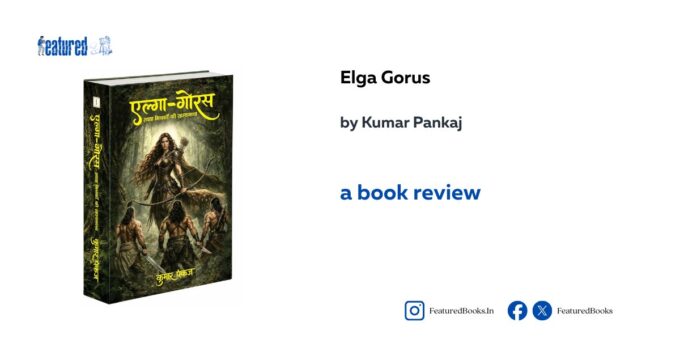
Halfway through the first volume of Elga Gorus, I found myself doing something I rarely do anymore as a reader. I stopped reading for a few minutes, closed the book, and simply sat there thinking about the world I had just visited. Not because I was confused, and certainly not because I was overwhelmed, but because I was trying to understand how a single writer had managed to construct something so elaborate, so unusual, and yet so internally convincing. Most novels reveal their strengths gradually. Elga Gorus announces its ambitions very early, but what makes it remarkable is that it actually lives up to them. Across two expansive volumes, Kumar Pankaj creates a world that feels simultaneously ancient and undiscovered, familiar and alien, mysterious and strangely believable. By the time I reached the later sections of the story, I realised that I was no longer evaluating the novel chapter by chapter. I had become completely absorbed in its reality, eager to see where its countless pathways, secrets, and legends would eventually lead.
What impressed me most was the author’s refusal to think small. Contemporary fiction often operates within carefully controlled boundaries. Stories unfold in a handful of locations, revolve around a limited cast of characters, and pursue a single narrative objective. Elga Gorus seems almost rebellious in comparison. It is constantly expanding. Every time readers feel they have grasped the dimensions of the world, the horizon moves further away. New mysteries emerge. New histories are hinted at. New beings enter the narrative carrying their own significance and unanswered questions. Yet the expansion never feels indulgent. Kumar Pankaj appears to understand that scale alone does not create wonder. What creates wonder is the feeling that every corner of a fictional world possesses its own story, whether or not the reader ever learns it in full. This quality gives the novel an unusual depth. There is always the sense that hidden beneath the visible narrative lies another narrative waiting to be discovered.
One of the novel’s greatest achievements is the way it transforms reading into an act of exploration. Most stories guide readers toward predetermined destinations. Elga Gorus often feels like a journey through unknown territory. Readers encounter strange ideas, cryptic histories, forgotten knowledge, and unusual beings without immediately being told how everything fits together. This approach demands curiosity, but it rewards that curiosity generously. The pleasure comes not only from discovering answers but from participating in the process of discovery itself. At several points, I found myself mentally connecting clues, revisiting earlier scenes, and reconsidering assumptions about the world. The novel encourages active reading. It does not hand over its secrets easily, and that makes every revelation more satisfying when it arrives.
Another quality that deserves appreciation is the author’s ability to sustain an atmosphere. Creating a compelling setting for a chapter or two is difficult enough. Sustaining a distinct atmosphere across two substantial volumes is far more challenging. Yet Elga Gorus maintains a remarkably consistent emotional texture throughout. There is a sense of mystery that never completely disappears. Even in moments of action, conversation, or revelation, readers remain aware that larger forces are operating beneath the surface. The world feels old. Not merely old in terms of chronology, but old in the sense that it contains accumulated memories, forgotten struggles, buried truths, and long-standing secrets. This feeling of depth contributes enormously to the novel’s appeal. Readers are not simply moving through locations. They are moving through layers of history.
The visual imagination displayed throughout the novel is extraordinary. Certain books provide information. Others provide images. Elga Gorus belongs firmly to the second category. I can still recall numerous scenes long after finishing the story, not because they were described in excessive detail but because they were described with precision and confidence. The landscapes possess character. The strange creatures possess presence. The mysterious locations feel tangible enough to visit. Kumar Pankaj understands the importance of sensory detail, but he also understands restraint. He provides enough information to stimulate the reader’s imagination while leaving room for that imagination to participate in constructing the world. The result is a reading experience that feels unusually immersive. Many fantasy novels tell readers what to see. Elga Gorus makes readers feel as though they are seeing it themselves.
The characters contribute significantly to this immersion. What struck me was not simply the number of characters but the variety of perspectives they introduce into the story. Every major figure appears to carry a unique relationship with the world around them. Some approach mystery with reverence, others with suspicion, others with ambition. Their differing viewpoints enrich the narrative and prevent the mythology from becoming static. Rather than existing as passive participants in a predetermined plot, the characters often feel like individuals whose choices actively shape the unfolding story. This gives the novel an energy that remains engaging throughout both volumes. Readers become invested not only in what happens but in how different characters interpret what is happening.
One aspect that particularly impressed me was the author’s willingness to embrace uncertainty. Modern storytelling often feels obligated to explain everything. Every mystery must be solved. Every symbol must be decoded. Every ambiguity must be clarified. Kumar Pankaj takes a more confident approach. He understands that some of the most memorable fictional worlds derive their power from retaining elements of mystery. Even when important questions are answered, new possibilities emerge. This creates a sense of openness that lingers after the final page. Readers finish the novel with the feeling that the world continues to exist beyond the boundaries of the narrative. Few literary experiences are more satisfying than that.
Well, let’s be honest! The qualities that make Elga Gorus distinctive may also limit its appeal for some readers. For starters, the novel requires attention and patience. Its large cast of characters, extensive mythology, and gradual approach to revelation mean that it cannot be skimmed casually. Readers who prefer tightly compressed narratives or immediate explanations may occasionally find themselves wishing for greater simplicity. There are moments when the sheer abundance of ideas demands careful concentration. Similarly, because the author prioritises atmosphere, mystery, and world-building, some readers may feel that the story occasionally pauses to deepen the setting rather than accelerate the plot. These observations, however, arise primarily from the novel’s ambition rather than from any lack of skill. The world is large because the author intends it to be large, and experiencing it fully requires a willingness to slow down and inhabit it.
What ultimately stayed with me after finishing both volumes was not any single scene or revelation, but a feeling. It was the feeling of having encountered a writer who trusts the power of imagination without reservation. Kumar Pankaj never appears embarrassed by wonder, mystery, or grand storytelling. On the contrary, he embraces them completely. In an era when many novels strive for minimalism and restraint, Elga Gorus feels refreshingly expansive. It seeks to astonish. It seeks to transport. Most importantly, it seeks to create a world worth visiting. For readers who miss the excitement of discovering something genuinely different, who enjoy stories that reward curiosity, and who appreciate ambitious world-building supported by strong narrative control, Elga Gorus offers a rare and memorable experience. It is a novel that asks for time and attention, but it rewards both generously. By the end, I felt less like someone who had completed a book and more like someone returning from a long and fascinating journey.
Want to read this one? Get a copy from Amazon India now – click here.
Review by Prabhat for Featured Books
Elga Gorus by Kumar Pankaj – Book Review
- Featured Rating
Summary
Wonderful! For Hindi fiction lovers, this will give them a nostalgic feel… a story that you can spend your summer vacation weeks with!