“Generative AI can be criticized because it offers quick and easy solutions, it can invent false references, it draws excessively on English, it sounds trustworthy when it is not, it always gives an answer even when it does not have one, it does not work for languages that have scarce electronic resources, and it can produce discourse as empty as that of politicians who have middle-of-the-road replies for everything they know nothing about.”
This is what attracted me very early as I started reading this book. Well, this is what it is! Gen-AI does make mistakes, fabricates proofs and works more on satisfying the user’s bias rather than treating things seriously. However, is it all? Can Gen-AI be trusted for the purpose of learning?
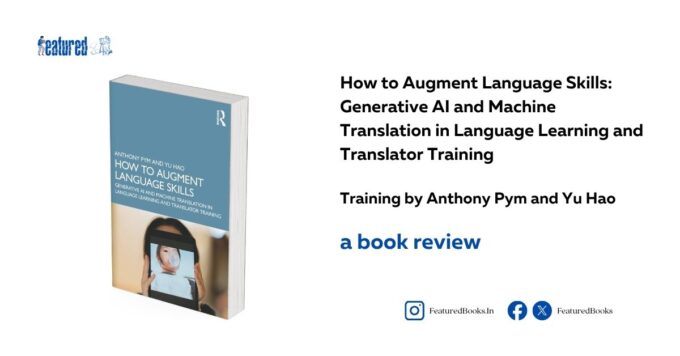
Anthony Pym and Yu Hao’s How to Augment Language Skills: Generative AI and Machine Translation in Language Learning and Translator Training is an unusually timely book because it refuses to treat artificial intelligence as either a miracle or a catastrophe. Published by Routledge in 2025, the book addresses a problem that language educators and translator trainers can no longer postpone: students already live with machine translation, large language models, translation memories, automated subtitling, and other forms of language technology, whether educational institutions are prepared for them or not. The authors’ central proposition is therefore practical rather than ideological. Technology should not simply be prohibited, nor should it be permitted to carry out the intellectual labour of learning. It should be taught, tested, questioned, and incorporated into the development of stronger human capacities. This position is established from the outset through an important distinction between automation and augmentation. For Pym and Hao, the real educational question is not whether machines can replace humans, but whether humans can use machines to become more capable language users, translators, writers, readers, and mediators. The preface gives the book its larger humanistic frame by linking language learning to multilingual social life, cultural identity, professional mediation, and communication across linguistic boundaries. The authors consequently understand technological change as something that can either enlarge or diminish multilingualism depending on how it is taught and used.
One of the book’s strongest intellectual decisions is its historical treatment of technology. Rather than presenting generative AI as an unprecedented rupture that suddenly descended upon language education, Pym and Hao place it within the much longer history of technologies that have extended human capacities. Their discussion of paper, the printing press, writing systems, dictionaries, grammars, and digital tools allows them to make a more consequential argument: technological mediation has always been part of language practice. What is novel today is not the existence of mediation but the extraordinary scale, speed, accessibility, and probabilistic power with which language can now be stored, retrieved, transformed, and generated. The authors reduce the underlying logic of much contemporary language automation to two broad processes, the recycling of previous language and the prediction of likely linguistic sequences. That formulation is particularly useful because it strips away some of the mythology surrounding AI while preserving a proper sense of its power. At the same time, the authors do not overlook the philosophical tension between automation and pragmatics. If language is dependent on context, purpose, voice, cultural inference, and the particular people involved in a communicative situation, then no amount of statistical fluency automatically guarantees appropriateness. This is one of the book’s most intellectually responsible features. It neither anthropomorphises the machine nor dismisses it. Instead, it asks what kind of human judgement becomes necessary precisely because automated systems are increasingly competent.
The book becomes especially persuasive when it turns from general arguments to curriculum design. Rather than assuming that every language professional requires mastery of every available tool, Pym and Hao advocate transferable competencies. Their discussion of needs analysis is particularly valuable because it challenges the familiar but simplistic practice of designing curricula first and asking whether they correspond to actual professional needs later. The authors call for input from institutions, employers, teachers, students, graduates, and other stakeholders, while making the important observation that students themselves may possess more current knowledge of technologies than the people who teach them. Their discussion of graduate employment strengthens this position. A Melbourne survey discussed in the book found that only about one third of recent translation graduates had entered translation or interpreting, while others moved into language teaching, administration, finance, retail, consultancy, and other professions. That finding prevents the curriculum from being reduced to narrow translator training. More importantly, the graduates themselves continued to value advanced language ability, intercultural competence, communication, critical thinking, project management, and risk management, while technology-related skills were more strongly prioritised by those actually working as translators. The implication is subtle but important: technological competence is necessary, but it should not displace linguistic and interpersonal competence. The authors therefore make a convincing case for teaching students how to learn new technologies, evaluate their usefulness, and judge when they should or should not be trusted.
The practical centre of the book is Chapter 5, where the authors provide 57 activities for language and translation classrooms. This section substantially elevates the book above a conventional discussion of AI in education because it demonstrates what an exploratory pedagogy might actually look like. The activities are not designed merely to train students in operating software. Many of them require students to compare human and automated outputs, investigate instability, identify cultural problems, examine bias, test terminology, evaluate sources, and reflect on their own decisions. The “machine translation ping pong” activity, for instance, has students move sentences repeatedly between languages and systems in order to observe where meanings stabilise and where transformations begin to accumulate. Other exercises invite students to compare terminology generated by machine translation, generative AI, dictionaries, glossaries, and parallel texts. The subtitling activities are equally revealing. Students first create subtitles without automation, then compare their work with automated speech recognition, machine translation, and post-editing workflows, allowing them to see precisely what technology gains and what it loses. The authors even make room for play, transcreation, alternative subtitling, and transdubbing, thereby treating creativity not as an abstract human possession but as something students can actively test against automated systems. Such activities embody the book’s most valuable pedagogical principle: students should encounter technology empirically rather than inherit either enthusiasm or fear from their teachers.
Yet the book is strongest when it admits that augmentation is not ethically innocent. Its treatment of voice, academic integrity, ownership, confidentiality, bias, and environmental cost gives the discussion a seriousness that many technology books conspicuously lack. One of the most insightful observations concerns generative AI’s tendency toward linguistic normality. The authors note that when several users provide similar prompts, the resulting texts can become strikingly alike, creating a danger that students may gain efficiency while gradually losing a sense of individual linguistic identity. That concern is not framed as a sentimental defence of purely human writing. Rather, it becomes a question of what education is supposed to cultivate. The discussion of intellectual property is similarly nuanced. The authors examine the tension between shared linguistic resources and the increasingly corporate ownership of translation data, observing that translation memory systems can absorb the linguistic labour of translators while depriving them of control over that accumulated linguistic capital. They are equally candid about confidentiality and ecological cost. Their discussion of the carbon footprint associated with training machine translation systems asks a difficult but necessary question: what social benefits could justify the environmental costs of computational language technologies? This ethical range is important because it prevents the book’s central argument for technological literacy from becoming technological advocacy. The authors remain aware that efficiency, accessibility, and convenience can coexist with exploitation, homogenization, surveillance, inequality, and loss.
The chapter on assessment is another significant contribution because it addresses one of the most difficult consequences of generative AI for education: once students can generate, revise, translate, and even receive feedback on texts through machines, what exactly should teachers assess? Pym and Hao do not pretend that automatic evaluation solves the problem. Their discussion of BLEU and METEOR illustrates the limitations of numerical measures that may correlate well at the aggregate level while remaining unreliable when judging individual texts or nuanced social and ethical appropriateness. The book similarly recognises the potential usefulness of generative AI for feedback, self-editing, topic development, organisation, and stylistic revision, but places these benefits alongside concerns about learning loss and academic integrity. Their proposed direction is therefore towards broader assessment of transversal capacities such as self-learning, teamwork, critical judgement, reflection, and the ability to use technology in ways that actually improve creative work. This is persuasive, although it also exposes one of the book’s unavoidable limitations. Its practical examples are necessarily embedded in a rapidly changing technological environment, and several discussions are tied to particular platforms, interfaces, and capabilities available at the time of writing. The authors themselves are conscious that technological knowledge is systematically belated and that students must be prepared to evaluate systems that do not yet exist. That awareness saves the book from becoming obsolete in principle, but some individual examples and software references will inevitably date more quickly than its pedagogical framework. In other words, the lasting value of the book lies less in memorising its current toolset than in learning the evaluative habits it recommends.
All said and done, How to Augment Language Skills is most successful as a book about educational judgement rather than as a book merely about artificial intelligence. Its argument is not that teachers should surrender authority to machines, nor that students should be protected from technology in the name of older ideals of linguistic purity. Its deeper proposition is that education must teach people to inhabit a technologically mediated linguistic world without surrendering the capacities that make language meaningful in the first place. This is why the final chapter’s tempered optimism is convincing. Pym and Hao acknowledge the possibility that automation may weaken motivation to learn languages, contribute to the erosion of certain skills, or diminish the social pool of professional mediators. Yet they also insist that technological access has democratized language learning and translation and has opened forms of multilingual participation to people who were previously excluded. Their preferred future is one of greater accessibility, greater interactivity, wider linguistic coverage, and greater user control over linguistic data. Such a future requires neither blind faith nor nostalgic resistance, but disciplined experimentation and human responsibility. The book’s greatest merit is therefore its refusal of easy answers. It recognises that the central educational task is no longer to keep the machine outside the classroom. It is to ensure that when the machine enters the classroom, language, judgement, creativity, cultural understanding, and human agency do not leave it. For teachers, translator trainers, curriculum designers, and serious students of language, that makes this a substantial and intellectually responsible contribution to an unsettled field.
Get a copy from Amazon – click here.
Sarthak for Featured Books
How to Augment Language Skills: Generative AI and Machine Translation in Language Learning and Translator Training by Anthony Pym and Yu Hao: A Critical Review
- Featured Book's Rating
Summary
Interesting premise, authentic arguments, thought-provoking content…