
Some stories entertain, and others reach into something older, something shared across generations, something that feels like memory even when it is written on a fresh page. Reign of Pawns, the upcoming novel by V. S. Edwár, feels poised to belong to the second category. Although it is a contemporary mystery thriller with characters scattered across the modern world, what makes this book particularly enticing for Indian readers is its quiet yet unmistakable connection to the Mahabharata, not through retellings or direct replicas, but through an echo that travels between the ancient world and our present time.
For readers who grew up listening to the stories of Shantanu, Ganga, Satyavati, the sons of Pandu, and the sons of Dhritarashtra, the Mahabharata is more than mythology. It is heritage, philosophy, imagination, and moral theatre. What makes Reign of Pawns so intriguing is its willingness to acknowledge that these legends do not belong to history alone. The novel seems to ask a provocative question. What if those echoes never faded? What if the forces that shaped ancient destinies found their way into the modern world? What if the past is not behind us, but moving silently alongside us?
The book does not reveal its secrets easily, and that is precisely why it promises such a rewarding reading experience. Indian readers are already familiar with complex stories that unfold through fate, lineage, devotion, betrayal, and cosmic order. Edwár uses that cultural familiarity as a subtle thread, weaving it into a narrative that begins with abductions, global intrigue, and impossible coincidences. The present-day plot unfolds through suspense and mystery, but beneath it flows an undercurrent of mythic remembrance. It is never forced. It arises naturally, like a long-buried story resurfacing on its own.
One of the strengths of the novel is its respectful treatment of mythology. The Mahabharata is not inserted merely for drama. It is used with sensitivity as a mirror that reflects the characters’ emotional and psychological layers. There is a careful balance at work. The modern story stands on its own. It has its own tensions, its own relationships, its own fears and hopes. Yet the ancient tales appear like guiding lights in a foggy landscape, helping the reader notice patterns that the characters themselves are only beginning to understand.
Indian readers will particularly appreciate how Edwár leans into the timelessness of these stories. The Mahabharata has always addressed questions of duty, destiny, power, moral choice, and the unseen threads that link one life to another. Reign of Pawns appears to draw from that same well of wisdom while staying firmly rooted in the twenty-first century. The result is a narrative where ancient themes slip quietly into modern settings. They transform the story without overwhelming it.
What is most impressive is that the novel’s appeal goes far beyond India. By using mythology as a bridge rather than a boundary, Edwár has created a narrative that feels globally accessible. Readers from anywhere in the world can appreciate the thrill of mystery, the tension of captivity, the emotional turmoil of encountering the unknown, and the beauty of stories that echo across the centuries. The Mahabharata becomes not just a cultural anchor but a narrative device that expands the story’s reach. It gives the book an identity that is proudly Indian and universally engaging.
This mixture of local depth and global readability is rare. Many books that draw from mythology do so for spectacle or nostalgia. Reign of Pawns seems to use mythology to raise questions rather than answer them. It allows readers to sense that something ancient is unfolding within the modern storyline without revealing it directly. That sense of anticipation, especially for Indian readers, becomes one of the book’s most potent charms. The emotional familiarity of the epic blends beautifully with the freshness of a contemporary thriller.
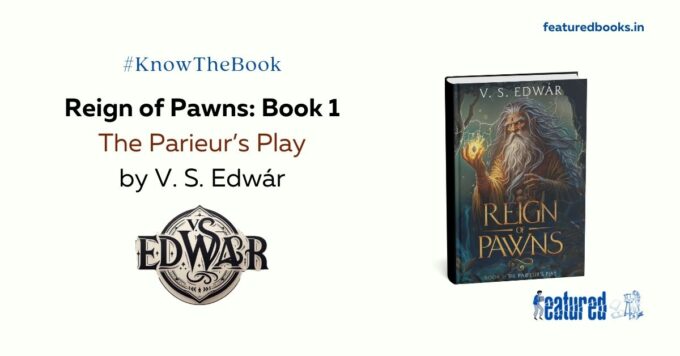
The cover itself hints at the book’s mythic resonance. The white-haired figure, fierce in expression and calm in power, holding a glowing jewel against a background of crackling energy, looks like a guardian from another age. For Indian readers, there is an instinctive recognition. This is a figure who belongs to the realm of sagas, where divine intervention, curses, boons, and extraordinary destinies were part of human life. The presence of such imagery invites the reader to ask whether the novel they are holding is only a thriller or something much more layered.
The blurb adds to the intrigue without revealing too much. Five strangers from different parts of the world. A mysterious imprisonment. Memories that no longer cooperate. Clues that whisper of ancient patterns. A labyrinth of magic, myth, and danger. For Indian readers, these hints suggest not only suspense but the possibility of a deeper cosmic structure behind the events. The threads of the Mahabharata often revolve around individuals who are unaware of the mighty narrative they are part of. Reign of Pawns seems to follow this tradition by presenting characters who find themselves swept into forces they cannot immediately comprehend.
What makes this upcoming December release especially exciting is that it appears to be the beginning of a larger saga. With the subtitle The Parleur’s Play, the book invites readers to expect more to come. For readers who enjoy long arcs that combine mythology with contemporary drama, this is an opportunity to join a journey from the very first step.
Indian readers often look for books that respect their cultural memory while offering something new. Reign of Pawns seems prepared to deliver exactly that. It merges the weight of an ancient epic with the pace of a modern thriller. It avoids the common trap of retelling mythology and instead creates a fresh narrative where the past breathes quietly through the present. The effect is powerful and inviting.
As the second week of December approaches, readers who enjoy mystery, mythology, philosophical depth, and global adventure have every reason to watch for this book. Something is captivating about a story that dares to ask if the ancient world still speaks. Reign of Pawns suggests that the answer might be yes, and that the voice of the past might still be shaping the world we live in. For Indian readers, this is a novel that feels both familiar and entirely new, both rooted and imaginative, both intimate and vast.
And for readers around the world, it is a chance to experience a story in which mythology and modernity coexist, creating a narrative that feels timeless.
You can pre-order the book from Amazon here – click here to get one now.
By Kundan for Featured Books
..
.