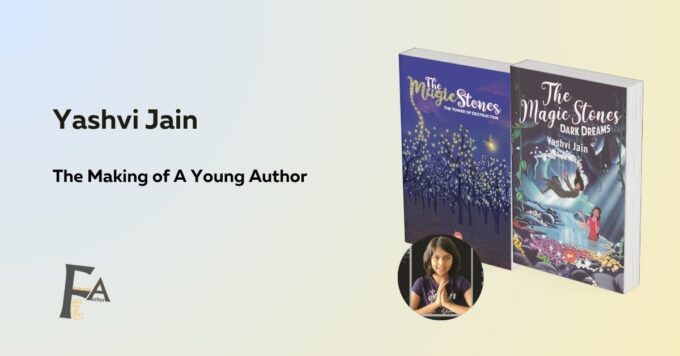
Yashvi Jain’s journey as a writer began with an impulse that is both simple and revealing: she was an avid reader who eventually found herself looking for books that could offer the kind of mystery, fantasy, suspense and humour she enjoyed, and when those worlds seemed to run out, she decided to create one herself. That impulse led to The Magic Stones, begun when she was only eleven, and subsequently to The Magic Stones II: The Tower of Destruction. What distinguishes her journey is not merely the age at which she began writing, but the continuity of her engagement with fiction. She has moved from being a young reader searching for imaginative worlds to becoming an author capable of sustaining one across multiple books. The first volume establishes Flora and Rosy within a mystery-driven adventure that begins at a Halloween carnival, while the narrative gradually opens towards a larger supernatural world. Her early writing is energetic, direct and driven by the instinct to keep the reader moving from one discovery to the next. It bears the unmistakable marks of a young writer, but it also establishes the central quality on which her later work develops: an abundance of imaginative possibilities.
The second book is where that development becomes more visible. The Magic Stones II does not simply reproduce the pattern of the first adventure; it enlarges the fictional universe and gives its protagonists more complicated circumstances in which to act. Flora and Rosy enter Astrolen, confront the Dark Dreams, encounter Dolores, discover more about their powers and become involved in a struggle that threatens an entire population. The magic stones themselves acquire a wider significance, while the Astrolen gem becomes central to the survival of the world Yashvi has created. This expansion suggests that Yashvi is gradually learning one of the essential disciplines of series fiction: a successful imaginary world cannot depend indefinitely on novelty alone; it must acquire internal rules, history and consequences. Her second book consequently shows a greater interest in the mechanics of the world as well as in the adventures taking place within it. The characters begin to understand their abilities, confront their limitations and make decisions whose consequences extend beyond their immediate circumstances. In one sequence, for instance, the protagonists must contend with a moral dilemma involving prisoners whose survival is tied to the maintenance of the Tower of Destruction, prompting Flora to question whether a decision made under such coercive circumstances can genuinely be called a choice.
This developing complexity corresponds closely with Yashvi’s vision of storytelling. She does not regard fiction merely as an instrument of escape, nor does she want to burden young readers with overt moral instruction. Her preference is to place questions inside the story and allow readers to negotiate them through the experiences of the characters. Most significantly, she wants to challenge the uncomplicated hero-versus-villain structure traditionally associated with children’s fantasy. Her intention is to create moral grey areas in which readers are required to reconsider who deserves to be called a hero, who becomes a villain and whether such categories are as stable as they appear. The books already contain glimpses of this approach. Flora and Rosy do not automatically trust the guardians of Astrolen simply because those characters appear to represent the side opposing Dolores; instead, they question the guardians’ motives and their own obligation to help them. Likewise, the protagonists’ extraordinary abilities are not presented solely as sources of empowerment. Flora becomes conscious of the possibility that uncontrolled power can cause harm, introducing responsibility into what might otherwise have remained a conventional fantasy device. These are still developing ideas, but they reveal that Yashvi is attempting to make her fantasy address questions that extend beyond fantasy itself.
There is, consequently, an important distinction between Yashvi’s present achievement and her future potential. Her writing still carries the characteristics of an emerging author. The prose can be expansive where greater economy would strengthen it; action, dialogue and emotional reactions sometimes arrive with more speed than control; and certain ideas could acquire greater force through subtler characterisation and more disciplined revision. These are not insignificant matters. Imagination alone does not produce accomplished fiction, and the next stage of Yashvi’s development will depend upon acquiring greater command over language, pacing, structure and character psychology. What is encouraging, however, is that her conceptual ambition appears to be developing alongside her craft. The second book demonstrates a willingness to enlarge the world rather than merely repeat it, while her reflections on storytelling indicate that she is already thinking beyond plot towards questions of audience, responsibility and interpretation. Her academic interests in Computer Science, Physics and Mathematics, alongside her intention to pursue computer science and AI programming, also suggest a mind comfortable with systems, patterns and the construction of complex structures. The connection between those interests and her fiction need not be overstated, but the coexistence is certainly intriguing.
Yashvi Jain, therefore, is best regarded not as a finished young author but as a promising writer in the process of becoming one. Her greatest asset at present is her imagination, but imagination is only the starting point; what makes her trajectory worth following is her evident desire to give that imagination greater purpose. She has already progressed from a relatively contained mystery-adventure to a more expansive fantasy world populated by its own mythology, powers, conflicts and ethical questions. More importantly, she appears increasingly conscious of the responsibility involved in writing for young readers. Her ambition to replace easy moral certainties with uncertainty, questioning and individual judgement gives her work a direction that could become more distinctive as her technique matures. The limitations of her present prose are therefore less important than the trajectory visible behind them. If she continues to read widely, revise rigorously and resist the temptation to settle for the first version of an idea, Yashvi has the imaginative resources to develop considerably as a writer. The books so far are evidence of promise; the more significant question is what she will learn to do with that promise. I do hope she brings more for readers who have appreciated her work so far.
Sarthak for Featured Books